


By Costanza Genoese Zerbi | Costanza Genoese Zerbi & Associates, eXp Realty | Long Beach, South Bay & Orange County Real Estate
If you're planning to buy a condo in Long Beach, the South Bay, or anywhere in Orange County, a major change to condo financing is about to make loan approval significantly harder for a lot of buildings. Fannie Mae has issued Lender Letter LL-2026-03, and starting August 3, 2026, condo lending will never work quite the same way again. As a Long Beach REALTOR® who has closed over 600 transactions and represents buyers and sellers across the Long Beach coastal submarket and the greater South Bay, I'm breaking down exactly what's changing, why it matters, and what it means if you're buying or selling a condo this year.
What Is Fannie Mae Lender Letter LL-2026-03?
Fannie Mae Lender Letter LL-2026-03 is an official policy update that changes how condominium projects are reviewed for conventional mortgage eligibility. The letter retires the Limited Review process, expands Full Review requirements, raises HOA reserve funding minimums, and removes the investor concentration cap that used to limit financing in investor-heavy buildings. These changes affect any buyer using conventional, Fannie Mae-backed financing to purchase a condo, and they affect current condo owners whose buildings may now be harder, or in some cases easier, to finance.
1. Limited Review Is Retired, Effective August 3, 2026
Effective August 3, 2026, lenders can no longer use the streamlined Limited Review process for established condo projects with more than 10 units. Limited Review previously allowed lenders to approve a condo loan without a deep dive into the HOA's finances. That shortcut is gone.
2. Full Review Becomes the Default for Almost Every Condo Loan
With Limited Review retired, nearly every condo loan on a building with more than 10 units will now require a Full Review. A Full Review means the lender must evaluate:
- The HOA's annual operating budget
- Reserve fund balances and funding levels
- Reserve study data, if the association uses one
- Master insurance policy coverage
- Owner delinquency rates
- Pending or active litigation involving the association
- Critical repairs and deferred maintenance
In practical terms, this means loan approval now depends heavily on the financial and structural health of the building itself, not just the buyer's credit profile and down payment.
3. HOA Reserve Requirements Increase From 10% to 15%
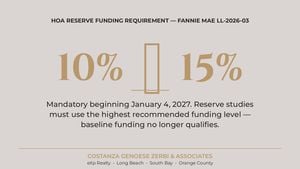
Beginning January 4, 2027, HOA reserve funding requirements rise from 10% to 15% of the association's budget. If the HOA relies on a reserve study instead of the standard percentage, that study must reflect the highest recommended funding level. Baseline funding levels will no longer qualify for conventional financing eligibility.
4. Waiver of Project Review Expands for Small Buildings
There is a meaningful exception for smaller properties. Condo projects with 10 units or fewer can bypass Full Review entirely through an expanded Waiver of Project Review. This is a real advantage for buyers and sellers of small boutique condo buildings across Long Beach neighborhoods like Belmont Shore, Belmont Heights, Bixby Knolls, California Heights, and Bluff Park, where smaller HOA structures are common.
5. The 50% Investor Concentration Cap Is Removed
Fannie Mae has also eliminated the old rule that blocked financing in buildings where more than 50% of units were non-owner-occupied. This change opens conventional financing back up for buyers looking at investor-heavy buildings that previously would have been ineligible.
Why This Matters for Long Beach, South Bay & Orange County Condo Buyers
Condo buyers in this market are used to focusing on their own financial picture: credit score, down payment, and debt-to-income ratio. Under Fannie Mae Lender Letter LL-2026-03, the building's financial health matters just as much. A buyer with a strong loan file can still be denied financing if the HOA is underfunded, behind on critical repairs, or involved in active litigation. Before writing an offer on a condo after August 3, 2026, it is worth having the HOA's budget, reserves, and insurance documents reviewed early in the process, not after you're already in escrow.
What Sellers Should Know Too
If you own a condo and are planning to sell, especially in a building with more than 10 units, it's worth understanding how your HOA would perform under a Full Review before you list. Buildings with underfunded reserves, unresolved litigation, or deferred maintenance may see a smaller buyer pool once conventional financing gets harder to secure. On the other hand, smaller buildings and investor-heavy properties may become more marketable than they were before.
How I Can Help
I work with condo buyers and sellers throughout Long Beach, the South Bay, and Orange County, and I'm already factoring these Fannie Mae condo lending changes into how I evaluate listings and advise buyers. HOA documents typically aren't available for full review until after an offer is accepted and escrow is open, so if you're considering a condo purchase this year, I'm happy to walk you through what a Full Review is likely to surface for a specific building and help you build the right contingencies into your offer, so you're protected once those documents come through in escrow rather than caught off guard by them.
If you're relocating to the area, my Long Beach Relocation Guide and my
South Bay Relocation Guide both cover neighborhood-level detail that pairs well with understanding these condo financing changes.
Get in Touch
Costanza Genoese Zerbi & Associates | eXp Realty of Greater Los Angeles | DRE #01941438
1650 Ximeno Ave, Suite 300, Long Beach, CA 90804 | (562) 221-4527 | costanzagz.com
Frequently Asked Questions
When does the Fannie Mae condo Limited Review change take effect? August 3, 2026, for all loan applications dated on or after that date.
Which condo buildings are affected? Any project with more than 10 units. Buildings with 10 units or fewer can qualify for an expanded Waiver of Project Review instead.
When do the new HOA reserve requirements start? January 4, 2027, when the minimum reserve funding requirement rises from 10% to 15%.
Is the 50% investor concentration cap really gone? Yes, Fannie Mae Lender Letter LL-2026-03 removes the prior 50% investor concentration limit for established condo projects.
Check out this article next