


How Strategic Pricing Turned a $1.35M List Price Into a $1.6M Sale
By Costanza Genoese Zerbi · Sellers, Pricing Strategy
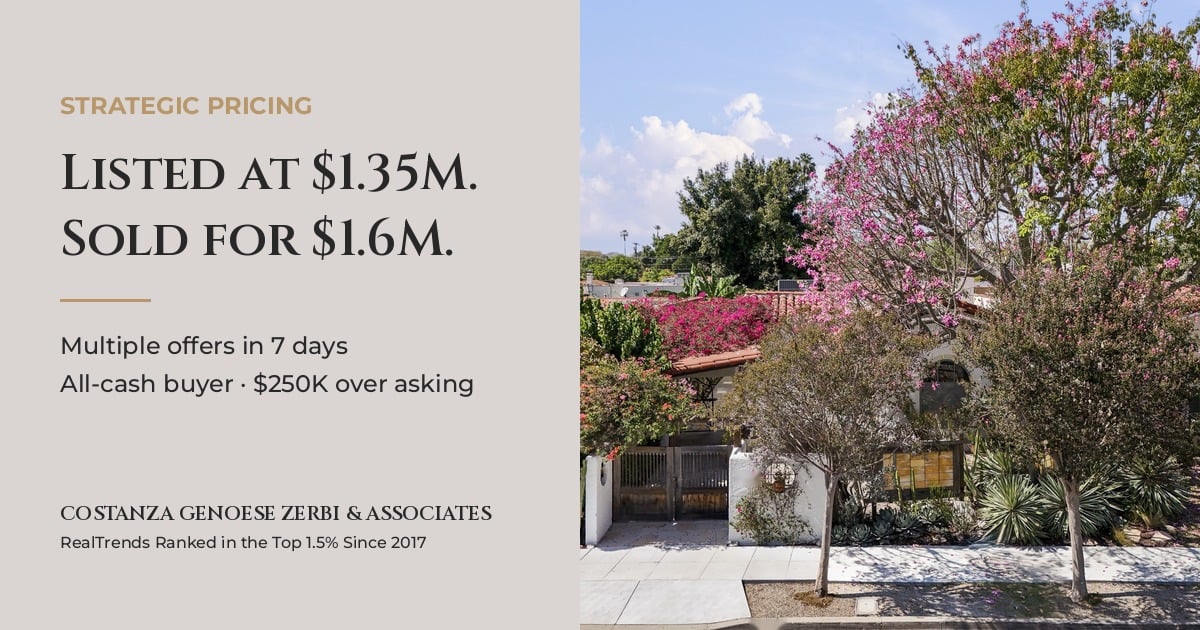
We just closed a 1932 Spanish-style home in Los Angeles. We listed it at $1,349,998. It sold for $1,600,000 to an all-cash buyer, after multiple offers in its first 7 days on the market.
That's $250,000 over asking. It didn't happen by luck, and it didn't happen because we "underpriced" it. It happened because we priced it on purpose. Here's how that works, and when it doesn't.
The numbers
List price | $1,349,998 |
Sale price | $1,600,000 |
Over asking | $250,002 (18.5%) |
Days to an accepted offer | 7 |
Offers | Multiple |
Buyer | All cash |
Escrow | Closed in under 30 days |
The list price is an invitation, not the final price
Most sellers think the list price decides what the home sells for. It doesn't. Buyers do.
The list price decides who shows up. Buyers search in price bands. A home listed at $1,349,998 shows up for everyone searching up to $1.35M, $1.4M, $1.5M and beyond. A home listed at $1,599,000 never reaches the buyers searching at $1.4M, and some of those buyers can stretch.
More qualified buyers walking through the door means more competition. And competition, not the number on the listing, is what pushes the price up.
That's the strategy: price the home where it draws the biggest crowd of qualified buyers, then let them compete.
Strategic pricing is not the same as giving it away
I want to be clear about one thing, because it matters to sellers and to buyers.
We only price this way when the seller would genuinely accept an offer at the list price. Our seller would have. If a seller won't take the list price, listing there isn't strategy. It's bait, and it wastes buyers' time and money on inspections and appraisals.
Strategic pricing works because it's honest. The price is real. The competition is real. The result is whatever the market decides to pay.
What made it work
Pricing alone doesn't create a bidding war. The process around it does.
- We let the home's character lead. Original stained glass, arched windows, plaster niches and hand-painted tile are things buyers can't recreate. We put them front and center in the photos and the marketing instead of covering them up.
- We made targeted updates, not a renovation. Fresh paint throughout and a remodeled kitchen made the home feel ready without erasing its 1930s personality.
- We had disclosures done before we negotiated. Buyers bid with more confidence when they've seen the seller's disclosures up front. Fewer unknowns mean stronger offers and fewer surprises in escrow.
- We asked every buyer for their best and final on clean terms. We set the terms that mattered to our seller: as-is, a 30-day escrow, and contingencies removed within 7 days. Buyers knew exactly what it took to win.
- We kept backup offers warm. With other buyers still interested, the accepted buyer knew the seller had options. That kept escrow on track.
The result was a strong all-cash offer that closed in under 30 days.
When strategic pricing doesn't work
This isn't a trick that works on every home. I'd recommend a different approach when:
- The seller can't accept the list price. If $1,349,998 would have been a loss for our seller, we would have priced differently.
- The buyer pool is small. A very unusual property, or one at the top of its market, may only have a few true buyers. There may not be enough people to compete.
- Demand is soft. In a slow segment or a slow season, a low list price can simply become the sale price.
- The home needs major work. Buyers who expect a project tend to bid conservatively.
In those cases, accurate pricing from day one usually wins. Overpricing is the most expensive mistake of all. A home that sits loses momentum, and the eventual sale price often ends up lower than it would have been.
The right list price depends on the home, the street, the season and the buyers in that price range right now. That's why I start every listing with a detailed pricing analysis, not a guess. You can see more of the homes we've sold on our sold listings page.
Thinking about selling a character home?
Spanish Revival, Craftsman and mid-century homes sell differently than newer homes. The details that make them special need to be marketed, not hidden. We help sellers across Long Beach (from California Heights to Bixby Knolls), the South Bay and greater Los Angeles, including many trust, estate and downsizing sales of homes like this one.
Wondering what your home could sell for? Start with a home valuation, or read more about how we work with sellers.
Frequently asked questions
Does pricing below market leave money on the table? Not when there's enough demand. Competition between buyers usually pushes the price to, or past, the home's true market value. In this case the home sold 18.5% over its list price.
Should I list my home below what I want for it? Only if you'd truly accept an offer at the list price. The list price should be a number you're comfortable selling at, not a lure.
What if I only get one offer at the list price? That's the risk, and it's why this strategy is only right for some homes. A good pricing analysis looks at recent sales and current buyer demand before choosing this approach.
How do you decide the list price? I look at recent comparable sales, active competition, buyer demand in that price band and the home's condition and character. Then we talk through the strategy together before anything goes live.
Does this work in a higher interest-rate market? It can. Well-priced, well-presented homes still draw multiple offers, as this sale showed. It depends on the price range and how many buyers are active in it.
Get in touch
If you're thinking about selling in the next year, let's talk about the right pricing strategy for your home. Contact me here or read what past clients say in our reviews.
About the author
Costanza Genoese Zerbi is the founder of Costanza Genoese Zerbi & Associates at eXp Realty of Greater Los Angeles. She is RealTrends Ranked in the Top 1.5% Since 2017, with 600+ closed transactions and $525M+ in career sales volume, and was #1 in Long Beach by sales volume in the 2024 RealTrends rankings. She specializes in seller representation, including trust, estate and downsizing sales, across Long Beach, the South Bay, greater Los Angeles and Orange County. Before real estate, she worked in corporate marketing and advertising, and she holds a UC Berkeley degree and a UCLA Anderson MBA. DRE #01941438.
Check out this article next