


California's Transfer Tax Fight Is Heading to the Ballot. Here's What Every Southern California Seller Needs to Know.
By Costanza Genoese Zerbi | Costanza Genoese Zerbi & Associates | June 2026
If you own real estate in Southern California, a statewide ballot battle heading to voters in November 2026 could affect how much you walk away with at closing — not just this year, but for years to come. To understand what's at stake, you need to understand what happened in Los Angeles.
The Baseline: What California Sellers Pay at Closing
When you sell a home in California, you pay a documentary transfer tax at closing. The statewide county baseline is $1.10 per $1,000 of sale price — $1,100 on a $1 million home. Some cities add their own transfer tax on top of that. Culver City charges $4.50 per $1,000. Redondo Beach charges $2.20 per $1,000. Santa Monica charges $3.00 per $1,000.
For most Southern California sellers, transfer taxes are a manageable line item at closing. They have been for decades. Then Los Angeles changed the equation.
Measure ULA: What Los Angeles Did — and What It Actually Costs
In November 2022, City of Los Angeles voters passed Measure ULA, officially the Homelessness and Housing Solutions Tax. It was marketed as a mansion tax — a levy on ultra-high-value real estate sales to fund affordable housing and homelessness prevention. Voters approved it with 58% of the vote.
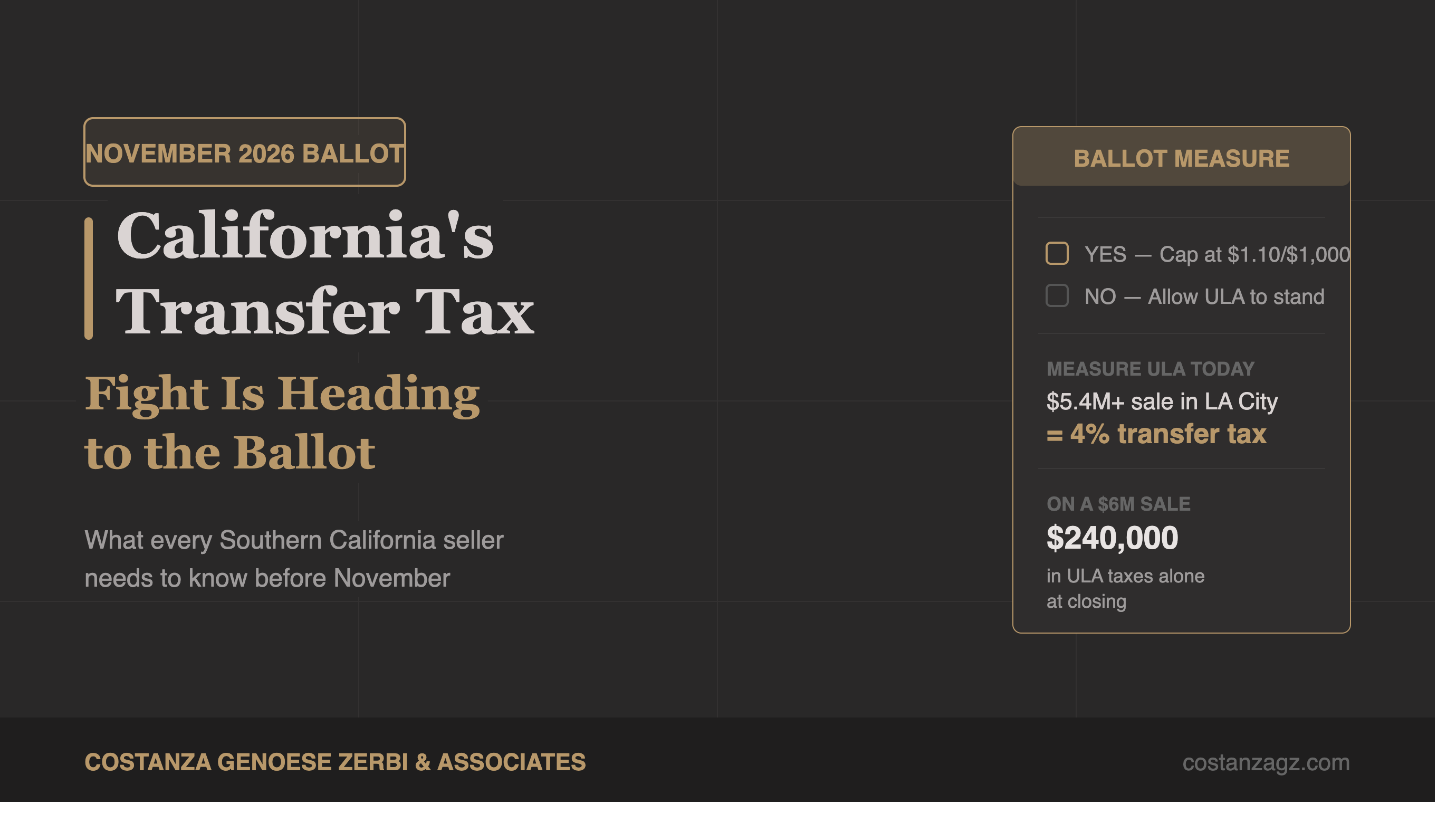
Effective April 1, 2023, any property sale within the City of Los Angeles above $5.4 million (the July 2026 threshold, adjusted annually for inflation) now carries an additional 4% transfer tax. Sales above $10.9 million are taxed at 5.5%. These rates apply to the gross sale price — not your equity, not your profit. The full sale price.
The math is stark. On a $6 million sale inside the City of Los Angeles, a seller owes $240,000 in Measure ULA taxes — at closing, on top of the existing county and city transfer taxes, on top of commissions, title, and escrow. On a $12 million sale, that number climbs to $660,000.
Measure ULA was sold as a mansion tax, but a $5.4 million property in Los Angeles is not always a mansion. It is often a mid-size apartment building, a commercial property, or a multifamily investment. Researchers at UCLA and the RAND Institute estimate that the policy has resulted in roughly 1,900 fewer apartment units built annually in Los Angeles since taking effect — including fewer affordable units. By early 2026, the tax had generated over $1 billion in revenue and remained fully in effect after surviving multiple legal challenges.
This is the backdrop for the statewide fight now heading to November's ballot.
The Howard Jarvis Local Taxpayer Protection Act
The Howard Jarvis Taxpayers Association — the organization behind Proposition 13 — has qualified the Local Taxpayer Protection Act for the November 2026 California ballot. It cleared the signature threshold in spring 2026 with more than 1.3 million submitted signatures.
If passed, the initiative would do two things. First, it would cap all documentary transfer taxes in California at the original state limit — $1.10 per $1,000 — eliminating the ability of cities to impose higher rates. Second, it would require any future local transfer tax increase to pass with a two-thirds supermajority of voters, not a simple majority. Measure ULA, which passed with 58%, would not have survived that threshold. Under the initiative, cities with transfer taxes above the cap — including Los Angeles — would be required to wind them down within two years of passage.
The broader impact would extend well beyond Los Angeles. Cities including Berkeley, Oakland, San Francisco, Santa Monica, Culver City, and Pomona all have transfer taxes above the state baseline. All would be affected. According to a Legislative Analyst's Office analysis, the initiative would cost local governments a couple of billion dollars per year statewide.
The Competing Proposal: AB 736
On June 25, 2026, Assemblymember Buffy Wicks introduced AB 736, a competing legislative proposal that would cap California transfer taxes at 3% statewide, with most cities limited to 1.5%. The stated goal was to offer the Howard Jarvis campaign a reason to stand down by providing a legislative compromise that addresses Measure ULA without eliminating all local transfer tax authority.
As of this writing, the deal has not held. Howard Jarvis Taxpayers Association president Jon Coupal said the organization would not pull the Local Taxpayer Protection Act from the November ballot despite, in his words, intense political pressure. Several major donors to the Jarvis campaign — including the California Business Roundtable and large commercial real estate operators — have shifted support to the Wicks bill. Whether that legislative maneuvering changes the November ballot picture before the deadline remains to be seen.
Polling on the Howard Jarvis initiative is mixed. Early surveys showed more than 57% of likely voters opposing the measure when shown its ballot title — including a majority of Republicans. That said, the measure is qualified and the campaign is active.
What This Means for Southern California Sellers
If you are selling inside the City of Los Angeles at or above the Measure ULA thresholds, November's vote could directly reshape your closing costs. A Jarvis victory winds down ULA. A Jarvis defeat — combined with a stalled AB 736 — leaves the current structure in place and the door open for other cities to consider similar measures in the future.
If you are selling in Long Beach, the South Bay, Orange County, or anywhere outside the City of Los Angeles, you are not subject to Measure ULA today. But this November vote will determine whether any California city can ever follow LA's lead — and under what conditions. That matters for long-term planning if you hold property anywhere in this state.
Transfer taxes are one line item in your closing statement. In most of Southern California today, they are a manageable one. What November decides is whether that stays true going forward.
The Bottom Line
California's transfer tax fight is a real policy battle with real dollar consequences for sellers across the state. The Howard Jarvis Local Taxpayer Protection Act is on the November 2026 ballot. AB 736 is moving through Sacramento. And Measure ULA — the law that started all of this — remains fully in effect in the City of Los Angeles.
As a RealTrends Verified top agent in Southern California, I watch every policy shift that affects my clients' net proceeds. I will be covering this issue as it develops between now and November.
If you are thinking about selling and want a clear picture of what you would net today — transfer taxes, commissions, and every other closing line — I am happy to walk through the numbers with you. That conversation is always free.
Costanza Genoese Zerbi & Associates
RealTrends Verified Top Agent Southern California | costanzagz.com | DRE #01941438
Check out this article next